Cambodia is intoxicating. It’s a juxtaposition of Southeast Asia’s most beautiful and most desolate – a land of poetry and poverty, a country unlike anywhere I had traveled to in this region, or rather – unlike anywhere in the world.
I was fortunate enough to spend a week there in July, as part of a long-awaited reunion trip with three university friends. They were visiting all the way from Chicago, coming to see Southeast Asia with fresh eyes and hopeful hearts. As the “host”, I recommended Cambodia – for its UNESCO world heritage sites, its well-developed tourist infrastructure, and the fact that I, despite visiting places here and there throughout this region, had never been. The truth was, I expected another Indonesia or another Thailand, except with Khmer replacing Bahasa and Thai on the streets. What we encountered, though, was a fiercely unique culture whose edges ripped through the mask of a Southeast Asia tourist utopia.
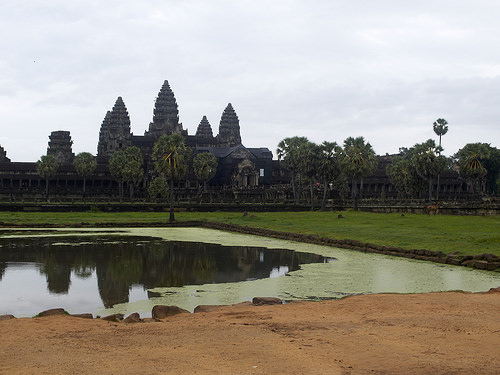
Tourists going to Cambodia often think of the majestic Angkor Wat, of serene temples shrouded in morning mist, monkeys and elephants, and of crimson-robed monks treading neatly past rice paddies. We began our trip in the northern tourist enclave of Siem Reap, where we saw all of that and more as our fantasies were indulged to the fullest. We went on shopping sprees in westernised night markets, snapping up elephant-printed pants for $2 and feeling unexpectedly rich. The next day saw a tuk-tuk ride to Angkor Wat at dawn, and an exploration of the vast temple compounds together with a million other tourists – Korean grandmothers in gawky tracksuits, French high school students in booty shorts. We admired the intricate carvings on the temples’ faded sandstone, but walked away without understanding their backstory.

Pieces of the real Cambodia unveiled themselves after we got on long-distance bus to Battambang, a sleepy local town 4 hours away from Siem Reap. For what seemed like eternity we drove past stretches of beautiful but barren countryside, devoid of the rubber or palm plantations that would line similar roads in Malaysia or Indonesia. In fact, it was devoid of economic activity. It was a painful reminder that as recent as thirty years ago, there were landmines, not rice, planted in the soil.
In Battambang, we strolled along a night market intended for locals. There were snack vendors with meagre bowls of fried crickets and vegetable laid out on the street next to piles of trash. The sight was uncomfortable, and it was only later that night I realised why – these were not the familiar scenes of prosperity that we had grew up with. The often overlooked fact was that Cambodia lagged behind its neighbours in development, by a lot. The country had not prospered from an influx of foreign investments like the rest of the region. “Cambodia did not have factories that manufactured glass, so all the Coca-Cola bottles are imported from Thailand,” A local told us. A thought-provoking fact.
We ended the trip in Phnom Penh – the capital. Looking back, that was where we should have started. At the genocide museum, located in a former high school turned Khmer Rouge detention facility, faces of executed inmates stared back at us. Suddenly it made sense – the hardened faces of tuk-tuk drivers, the aggressive stares of vendors – most of these people had lived through the Khmer Rouge regime. What was a dystopian nightmare for us had been their lives. This was why there was an extra element of rawness in the people, having lived through mass executions and now driven by the allure of tourist money.
In Phnom Penh the country’s extremes were enlarged. There was the beautiful royal palace and the wide French-built boulevards on the banks of the Mekong. But more often we saw dark streets and seedy bars that hid the city’s infamous sex industry. The rawness of Cambodia as a state in transition, the rampant poverty, the overwhelming noise… they lingered in my mind long after my return to Singapore. There had to be a better takeaway from this experience than simply to feel grateful for what I was born into, but what was it?
In the meantime, I continue to ponder.
Photo Credit: Mike Mei
 Musings of a Leaf